Pond muck: digest the organic layer
Muck is the organic layer that builds up because the bottom breaks it down slowly, without oxygen. Restoring oxygen at the sediment speeds aerobic digestion of the organic fraction, so the layer accumulates slower and, over seasons, thins. Mineral sediment doesn't digest, and a deeply filled pond may still need mechanical removal first.
What’s actually happening in your water
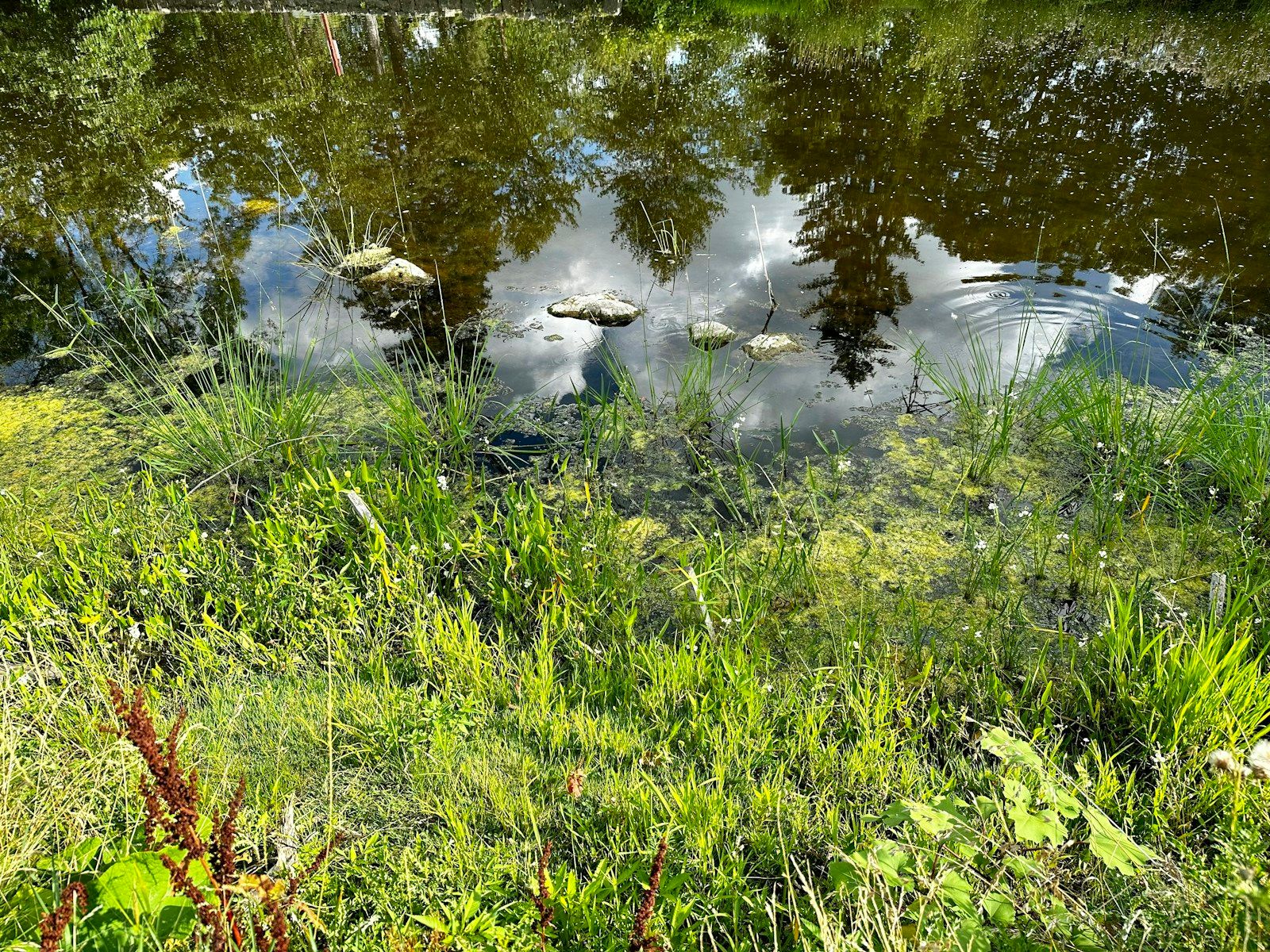
Muck is what’s left when organic material (fallen leaves, spent algae, plant die-back) settles to the bottom and doesn’t finish breaking down.
The reason it doesn’t finish is oxygen, again. Aerobic breakdown, the kind that needs oxygen, is fast and clean. Anaerobic breakdown, the kind that happens when the bottom has no oxygen, is slow and leaves a lot behind. That leftover is your muck layer. In most ponds it’s been thickening for years, because the bottom has gone without oxygen for years. The slimy feel underfoot is that half-finished organic material.
The muck is a record of a bottom that couldn’t breathe. That is why a fix can start with oxygen instead of a dredge.
Why the usual fixes don’t hold
Dredging works. It physically removes the layer. But it’s expensive, it’s a major operation, and on its own it doesn’t change why the muck built up. A dredged pond with an oxygen-starved bottom simply starts refilling.
Bacterial additives and pellets are sold to “eat” the muck. But they add biology to a bottom that lacks the one thing biology needs to work fast: oxygen. Without changing the condition, the additive is pushing against the same headwind that slowed things down in the first place.
How restoration works here
Restoring oxygen at the sediment interface speeds the aerobic digestion that was stalled. Nanobubbles carry oxygen down to the bottom, so the organic part of the muck breaks down faster and builds up more slowly. Over seasons, the organic layer can thin.
Two limits are worth stating up front. Only the organic part digests, and washed-in soil and sand never will. This is also slow work, measured in seasons rather than weeks. For a pond that’s already deeply filled, the right plan is sometimes a dredge to reset it, then oxygenation so it doesn’t fill back in. Over time that usually costs a fraction of repeated dredging.
We measure with a pole at fixed stations, season over season, and publish how we do it. The seasons when the number barely moves go in the record too.
What to expect, and when
Weeks 2-4
Oxygen reaches the sediment interface and aerobic digestion of the organic layer begins. The early change shows up in the oxygen reading rather than the muck depth. This problem is measured in seasons.
Season 1
Muck-depth readings at fixed stations, taken with a marked pole, give the first real measure of whether the organic layer has stopped growing.
Seasons 2-3
The organic fraction can thin measurably over several seasons. How much depends heavily on what the muck is made of. We measure it at the pole rather than promise a figure.
The record
We don't have a published case file for this problem yet. Every Alchemal installation is instrumented from day one, so the first case files are being measured now, and until one is ready, our methodology shows exactly what we record and how we report it.
When this isn't the right fix
- Digestion rates vary widely with what the muck is made of and how deep it is. Whether oxygenation meaningfully thins your layer is something we establish by measuring your pond in the first season rather than by quoting an average.
- Only the organic fraction digests. Mineral sediment (washed-in soil and sand) doesn't break down at all, and no amount of oxygen changes that.
- A pond that's been filling for decades may still need mechanical removal to reset it. Oxygenation's role there is keeping the muck from coming back after the dredge.
Questions people ask
What is pond muck, and where does it come from?
Muck is the soft, dark layer on the bottom: mostly the remains of leaves, algae, and other organic material that never fully broke down. It builds up because the bottom has little oxygen, and without oxygen that material breaks down slowly. The slimy feel underfoot is that partly digested organic layer.
Can I get rid of muck without dredging?
Often you can reduce the organic part of it without dredging, though slowly. Restoring oxygen at the bottom speeds the aerobic digestion that was stalled, so the organic layer accumulates slower and can thin over seasons. Mineral sediment won't digest, and a deeply filled pond may still need a dredge. We measure to tell which case you're in.
How much muck will this actually remove?
It depends on what your muck is made of, and we won't quote a number we haven't measured on your pond. The organic fraction digests; the mineral fraction doesn't. We set fixed stations, measure the depth with a pole each season, and report the number we read. If it moves less than hoped, the report says so.
Is oxygenation cheaper than dredging?
It's typically a fraction of a dredge and works gradually instead of all at once, and it addresses why the muck accumulated rather than just removing what's there. For a badly filled pond, the two can work together: dredge to reset, then oxygenate so it doesn't fill back in. The assessment puts real figures against your pond.
How do you measure whether the muck is going down?
With a marked pole at fixed stations, read the same way each season. It's a humble, physical measurement, and that's the point. You can stand at the same spot a year apart and read the number for yourself.
Tell us what your water is doing.
A specialist reads your description and replies in writing: what it usually means and what we would measure first.